... fees of £9000 a year...
... I don't know if I would have had the guts to take on that level of debt
... I don't know that if I'd left the decision until I was more sure of myself, that I could have taken the hit on my earnings
... I don't know whether it would have paid off in the long run
... I don't know whether the pressure to 'get value' would have trumped the need to grow as a person
... I don't know whether I would have felt the freedom to continue exploring my learning after university
... I don't know whether I would have done a postgraduate qualification
... I don't know that it would have been worth it.
I just don't know.
I do know that fees of £5000 a year from the Open University would have put my employer off sponsoring me. Which would have closed the door to the tutoring I started the year after my first course with them (I already had a degree from another university). Which would have closed the door to progression in a career that really did suit me. Which would have meant that I wouldn't have been able to take the higher degrees I needed for the profession I'm in. Which would have meant I wouldn't be working in Higher Education now.
Debt. Value. Money. Fees.
Learning? Changing lives? Those factors are apparently, are now secondary to everything else. We talk about improving 'employability' - and I get that. Now. To an extent. But, I don't know that my 17 year old self would have understood it. I don't know that I understood terribly much at that age. When I graduated, aged 20, I don't think that I'd made that link either. I think I probably thought the degree itself was the thing which got me the job. It didn't. But I wonder if it would have been better had I carried with me the panic that this was a once-only 'investment in my future' and, on finding myself on a degree which I couldn't really cope with... well... what would I have done with that? I can't see that version as better. I also don't like the version which says 'explain better to 17 year olds what they're taking on and the responsibility of their choices will be more solidly based'. Because the 17 year old version of me is nothing like the 36 year old version. And to be tied to the choices I made then for good? Well... that is a scary proposition.
If life long learning is about flexibility and growth... how does shackling people with debt and the pressure of high-stakes choices encourage that?
Faced with fees of £9000 a year, I'd question the worth of Higher Education.
Sunday, July 24, 2011
Tuesday, July 12, 2011
Google + blundering in the dark equals...
... a few quick tips.
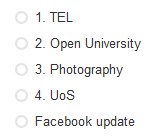
1. Circles seem to breed if you're not careful. Less is more. And less which get used in a purposeful way is even more than that!
2. Number your circles so that they sort in the order you want. By default, system created circles (i.e. Friends, Acquaintances, Following) sort above your numbered circles if you don't give them a number... so number those too!
3. The only formatting you can apply to text is bold, italic and strikethrough (thanks AJ Cann for that!) - to do that, just pop a couple of asterisks around the word you want emboldened... *bold* = bold ... for italic it's... _italic_ = italic and strikethrough is... -strikethrough- =strikethrough
4. Control your email notifications by going to Account settings > Google+ then adjust the notifications to suit.
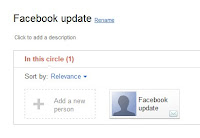 5. Post from Google+ to Facebook by going to their mobile site, copying your unique Upload via email address, go back to Google+ create a circle and call it something like 'Facebook update', then paste in the email address you just copied to the 'add a new person' field. Then, when you want to send something to Facebook, just share it with your Facebook update circle.
6. To quickly see all the people you've added to a circle, go to circles, right click and select 'View circle in tab'...
7. ... once they're in a tab, you can select the ones you want to remove or drag to another circle (or even block en masse)
 8. Only the things you +1 externally live in your +1 tab on your profile
9. If you want to see how your profile looks to others, there's a little 'view profile as' link on your profile page where you can see what people can view from within Google+ and what everyone else sees .
10. Sparks are good! Too lazy to sift through the 101 RSS feeds you enthusiastically subscribed to? Just type in a search term and it'll pull up related content. If it looks like something you want to see in the longer term, then pin the interest and you'll see it on your main Google+ page.
11. Mute annoying posts by using the dropdown arrow next to the post and selecting mute (or block the individual if you really want to!)
12. If you've uploaded more than one profile picture, you can toggle between pictures on your profile page, just by clicking on your picture.
13. Don't forget to explore the privacy options - make sure you have your profile under control... reveal the information you want to reveal and no more! Share the posts you want with the people you want... and control whether or not they can comment / reshare. Make active choices with this stuff!
That's about it at the mo. It's obviously a system under development. It doesn't quite feel like a rival to Facebook to me. Or a Twitter replacement. Or a Skype replacement. It doesn't really feel like any one thing as yet. It feels like a shell for other things. But, unlike Google Wave which was chaotic and frenetic, it has an order which feels more able to be useful.
... though I still have the nagging feeling that I'm being sucked into the big Google Machine with every click...
1. Circles seem to breed if you're not careful. Less is more. And less which get used in a purposeful way is even more than that!
2. Number your circles so that they sort in the order you want. By default, system created circles (i.e. Friends, Acquaintances, Following) sort above your numbered circles if you don't give them a number... so number those too!
3. The only formatting you can apply to text is bold, italic and strikethrough (thanks AJ Cann for that!) - to do that, just pop a couple of asterisks around the word you want emboldened... *bold* = bold ... for italic it's... _italic_ = italic and strikethrough is... -strikethrough- =
4. Control your email notifications by going to Account settings > Google+ then adjust the notifications to suit.
 5. Post from Google+ to Facebook by going to their mobile site, copying your unique Upload via email address, go back to Google+ create a circle and call it something like 'Facebook update', then paste in the email address you just copied to the 'add a new person' field. Then, when you want to send something to Facebook, just share it with your Facebook update circle.
6. To quickly see all the people you've added to a circle, go to circles, right click and select 'View circle in tab'...
7. ... once they're in a tab, you can select the ones you want to remove or drag to another circle (or even block en masse)
9. If you want to see how your profile looks to others, there's a little 'view profile as' link on your profile page where you can see what people can view from within Google+ and what everyone else sees .
10. Sparks are good! Too lazy to sift through the 101 RSS feeds you enthusiastically subscribed to? Just type in a search term and it'll pull up related content. If it looks like something you want to see in the longer term, then pin the interest and you'll see it on your main Google+ page.
11. Mute annoying posts by using the dropdown arrow next to the post and selecting mute (or block the individual if you really want to!)
12. If you've uploaded more than one profile picture, you can toggle between pictures on your profile page, just by clicking on your picture.
13. Don't forget to explore the privacy options - make sure you have your profile under control... reveal the information you want to reveal and no more! Share the posts you want with the people you want... and control whether or not they can comment / reshare. Make active choices with this stuff!
That's about it at the mo. It's obviously a system under development. It doesn't quite feel like a rival to Facebook to me. Or a Twitter replacement. Or a Skype replacement. It doesn't really feel like any one thing as yet. It feels like a shell for other things. But, unlike Google Wave which was chaotic and frenetic, it has an order which feels more able to be useful.
... though I still have the nagging feeling that I'm being sucked into the big Google Machine with every click...


Saturday, June 18, 2011
Rigor ends in rigor mortis...
I see that Michael Gove is now pushing for 'tougher exams' and an increase in rigor in education.
Always with the quick fix. Always with the achievement of a standard which can be measured. It doesn't matter that people come out of education with a dislike of learning. A lack of confidence in their own potential. Or their ability to grow and develop. No. What we need is 'more rigor'.
What's so bad about that? I mean. Shouldn't things be more rigorous? Isn't that better? Well... a good place to start is to look up what 'rigor' means in the dictionary...
Rigor: 1. harsh inflexibility in opinion, temper, or judgment
(Source: Merriam-Webster)
Oh, and if you're wondering, the alternatives for it aren't much better.
Is this really what we want for children's learning? Inflexibility in an age where to survive you need to be flexible? Or are we considering rigor as 'a condition that makes life difficult, challenging, or uncomfortable'? Still not looking massively attractive.
Now, I know by treating these kind of statements literally it could be argued that I wasn't being fair. That what he actually means is that we need to have 'better standards' for our qualifications. But what does *that* mean either? Qualifications don't equate to knowledge. They don't equate to a critical understanding. Fact retention or a test of memory in a 'rigorous' exam doesn't mean that you're more prepared to face a challenging, changing and complex world.
What I learned when I was at school was how to be invisible. This isn't strictly true... because it wasn't always like that. I was a curious child when I was little. Could spend hours reading or creating things. Loved finding out how things worked. But then secondary school happened. It was a vast sea of children and with its increased 'rigor' and reliance on tests, streaming and comparisons... I disappeared. I learned instead how to avoid the teacher's radar and survive. On paper I was one of the 'good' pupils. I got the 'good' GCSEs I needed. I got my A-Levels. I did a degree.
I didn't learn a damn thing that mattered.
How could I go through 16 years of education from 4 to 20 and, 15 years later, barely remember a thing from all those years? I have a degree in Economics - but I couldn't talk to you intelligently about Economics. On paper I can speak French and German. Laughable. I have an A-Level in Maths... but an allergy to trigonometry.
Only when I was in my mid-twenties did I realise that I could have a voice. That it was okay to be wrong. That the qualifications I'd been led to believe were all important and that I *had* to have weren't the door opener they were made out to be. That being 'good at school' wasn't the same as being good at learning. Only in my mid-twenties did I realise what I was interested in and had the intrinsic motivation to take myself to other more interesting places. I walked out of University aged 20 thinking 'I'm done with education'. Well, in many ways that's still right. The difference is that I have a further three degrees now... and I'm only just started with learning.
Rigor in education? On the list of important things about learning it is very, very low down the list. Apparently though, Gove would also like to see the influence of business as well as rigor...
Build a brand and create chains.
Build a brand. Create chains.
This almost leaves me speechless. Instead, I think that an author whose work I rather like can express some of my feelings better than me...
Learning. What is so wrong with learning? Messy, creative, exciting, enjoyable, fun, stimulating, puzzling... learning? You don't need a factory-like educational experience to learn. In fact, I wouldn't want an experience like that.
Yet here we are again. Governmental calls for rigor.
Real learning looks like it's about to enter a state of rigor mortis...
Always with the quick fix. Always with the achievement of a standard which can be measured. It doesn't matter that people come out of education with a dislike of learning. A lack of confidence in their own potential. Or their ability to grow and develop. No. What we need is 'more rigor'.
What's so bad about that? I mean. Shouldn't things be more rigorous? Isn't that better? Well... a good place to start is to look up what 'rigor' means in the dictionary...
Rigor: 1. harsh inflexibility in opinion, temper, or judgment
(Source: Merriam-Webster)
Oh, and if you're wondering, the alternatives for it aren't much better.
Is this really what we want for children's learning? Inflexibility in an age where to survive you need to be flexible? Or are we considering rigor as 'a condition that makes life difficult, challenging, or uncomfortable'? Still not looking massively attractive.
Now, I know by treating these kind of statements literally it could be argued that I wasn't being fair. That what he actually means is that we need to have 'better standards' for our qualifications. But what does *that* mean either? Qualifications don't equate to knowledge. They don't equate to a critical understanding. Fact retention or a test of memory in a 'rigorous' exam doesn't mean that you're more prepared to face a challenging, changing and complex world.
What I learned when I was at school was how to be invisible. This isn't strictly true... because it wasn't always like that. I was a curious child when I was little. Could spend hours reading or creating things. Loved finding out how things worked. But then secondary school happened. It was a vast sea of children and with its increased 'rigor' and reliance on tests, streaming and comparisons... I disappeared. I learned instead how to avoid the teacher's radar and survive. On paper I was one of the 'good' pupils. I got the 'good' GCSEs I needed. I got my A-Levels. I did a degree.
I didn't learn a damn thing that mattered.
How could I go through 16 years of education from 4 to 20 and, 15 years later, barely remember a thing from all those years? I have a degree in Economics - but I couldn't talk to you intelligently about Economics. On paper I can speak French and German. Laughable. I have an A-Level in Maths... but an allergy to trigonometry.
Only when I was in my mid-twenties did I realise that I could have a voice. That it was okay to be wrong. That the qualifications I'd been led to believe were all important and that I *had* to have weren't the door opener they were made out to be. That being 'good at school' wasn't the same as being good at learning. Only in my mid-twenties did I realise what I was interested in and had the intrinsic motivation to take myself to other more interesting places. I walked out of University aged 20 thinking 'I'm done with education'. Well, in many ways that's still right. The difference is that I have a further three degrees now... and I'm only just started with learning.
Rigor in education? On the list of important things about learning it is very, very low down the list. Apparently though, Gove would also like to see the influence of business as well as rigor...
Gove would welcome school heads taking a lesson from business: "We now have great headteachers who will become educational entrepreneurs. They will build a brand and create chains."(Source: The Guardian, 18 June 2011)
Build a brand and create chains.
Build a brand. Create chains.
This almost leaves me speechless. Instead, I think that an author whose work I rather like can express some of my feelings better than me...
Learning. What is so wrong with learning? Messy, creative, exciting, enjoyable, fun, stimulating, puzzling... learning? You don't need a factory-like educational experience to learn. In fact, I wouldn't want an experience like that.
Yet here we are again. Governmental calls for rigor.
Real learning looks like it's about to enter a state of rigor mortis...
Thursday, June 16, 2011
Universities are...
Loved this quote in the article 'An unofficially brilliant way to celebrate Universities Week'
"universities are made up of people – strange, passionate and playful people who are humbly curious about the world – and that's what makes them so much fun."
... and that's why, no matter how insane they are to try to get your head round. No matter how difficult it might be to make change. No matter how complex and frustrating. Universities are exciting places to work.
And being around people who have the courage to be passionate about something is addictive.
Now... about how to spread that a little wider than academia...
You can't knock my ambition, right? :o)
Friday, June 3, 2011
RIP older browsers, Google ain't playing any more...
BBC News - Google to abandon older browsers: "Google is phasing out support for older browsers from 1 August.
Those using IE7, Safari 3, Firefox 3.5 and their predecessors to view Gmail, Google Calendar, Talk, Docs and Sites will then lose some functions.
Eventually, it warned, these web services will stop working for those sticking with older browsers.
The move is part of a trend to stop the use of ageing browsers which can be insecure and not sophisticated enough to handle the latest web technologies."
Those using IE7, Safari 3, Firefox 3.5 and their predecessors to view Gmail, Google Calendar, Talk, Docs and Sites will then lose some functions.
Eventually, it warned, these web services will stop working for those sticking with older browsers.
The move is part of a trend to stop the use of ageing browsers which can be insecure and not sophisticated enough to handle the latest web technologies."
Bye, bye browsers. When the biggest boy decides it's not going to play with you, you might as well go home...
Mind you, the figures at the end of the article - that 34% of Chinese users are on IE6 suggests that size of audience doesn't matter so much as the direction the dominant player has decided to head in.
Google takes over the world. Again.
Sunday, May 22, 2011
The final pet bunny solution...
Pet rabbits are cruelly neglected and mistreated in Britain, survey finds | World news | The Observer:
My favourite quote from this article about pet rabbits being neglected...
"Rabbit meat is lower in fat, cholesterol and calories than chicken, pork and beef"... I feel a solution to the pet bunny crisis coming on...
PS My second favourite quote is this:
"bored and unhappy rabbits self-harmed and became aggressive and depressed"
... which a) makes me wish I was a cartoonist and b) wonder if bunnies masquerade as teenagers in an attempt to escape their carnivorous keepers...
Privacy in the age of Twitter

It feels sometimes as if one world is challenging the other. The judiciary are trying to enforce a world which they cannot get back. Where you pass an injunction and it sticks. When the media was filled with professional employers and employees it was far easier to regulate. Tell the newspapers and the television not to do it, and they'll behave. The public were easy to keep in the dark because they weren't the content creators, they were passive recipients. But now - who really makes up the media? I can sit and publish without any effort. The costs to me are minimal. And if lots of others are prepared to join in and repeat the 'offense' then hiding in that relative anonymity seems to open the floodgates to challenging rulings which appear nonsensical.
Gossipping over the garden fence on a global scale. How would you regulate for that? How could you regulate for that? Should you?
Existing in a state of the unknown is one thing. But, once something is known, you can't un-know it. There is no returning to a state of 'before'. Television isn't made of three channels. I don't have to buy a newspaper to stay informed. Stop one source and another starts. It's not necessarily a good thing. It's not necessarily a bad thing. But either way you can't pretend that a fundamental change hasn't happened. Pandora's box has been well and truly opened. I wonder when the courts will realise and stop trying to close it? The more ludicrous the situation, the more people will mock.
When will our out-dated copyright and privacy laws be examined in light of now and not in the shadow of then?
Sunday, May 15, 2011
e-learning isn't working...
Okay. That's a bit controversial... right? And, to be honest, if I didn't believe in the power and potential of learning in new and non-traditional ways (see how I skirt around calling it 'e-learning'?) then I wouldn't be working in this area. But, I come across the same problems time and time again and it's making me wonder if the 'e' in 'e-learning' isn't causing a whole lot of problems for its potential.
Problem 1: 'e-learning is basically IT in education, so it should be part of the IT department'
This fundamentally negates the massively important 'learning' part of the word. It relegates thinking about changing practices and experiences to second place whilst the technology pushes its way to the front. Big problem when you want to talk about thematic ideas and approaches and instead find yourself bogged down with which version is that, which bug fix is that detail. It doesn't move things forward, at best, it maintains. It's the equivalent of lumping lecturers in the 'furniture department' since their work involves people sitting at desks and chairs. It's not to say that the technology isn't important... but it isn't *the* most important thing.
Problem 2: Most people who end up in e-learning didn't intend to end up there
Over the years I've come across so many people who have the appearance of having woken up and found themselves in a job and a career which they never really intended happening. And on waking up, they sleepwalk through the rest of their job, never taking hold of the fact that to make something of it they need to balance the technical flair which often landed them there with some real educational experiences. Teaching, training, studying... becoming a professional. It isn't enough to 'help someone' develop something. You have to *know* it inside and out. You have to understand the implications of the decisions you're influencing and have a theoretical and practical foundation for your ideas. You have to bridge the gap between technology and teaching - treading deftly between the two. Translating and consolidating and not being afraid to stop once in a while instead of always chasing the next shiny bright thing.
Problem 3: e-learning is seen as a quick, cheap fix to the problems faced by education
'I know! Let's put the course online and we can bring in lots more students!!!' is the current cry... 'We can just put the lecture notes online... simple!'... and does this actually work? Does it really make for effective education? Sadly... and very very predictably... no. It is the instructive 'pour the facts into their heads and they'll be educated' model of education. It isn't real learning. It isn't making the most of what you've got and lighting any fire of passion for learning. And yet, so often this is how e-learning is viewed. 'At least it's a step in the right direction' is the defence for this abysmal practice. How so? When I was at university first, the boredom of the lecture theatre existed... but at least you had someone talking to you. Put the lecture notes online and you remove the last element of interest from it and it becomes meaningless. You don't offer opportunities to engage with and discuss... you document dump. It's pitiful.
Problem 4: e-learning is some how perceived as being different to other forms of learning
When was the last time you heard someone talking about 'pen learning' or 'paper learning'? When did you say 'I'm going to engage in a practical, experiential model of learning' as you followed a new recipe. You just did those things. By separating e-learning out from all other forms of learning it is easy to become detached. To be ignored. Rather than an ingredient you may or may not use from many in your support of students and your support of their learning... it's a thing apart.
Problem 5: In an academic world where the academic reigns supreme, e-learning is allowed to be a whim-based form of delivery
The model of Higher Education in the UK with its academic superstar structure means that poor teaching rarely gets challenged. When it does get challenged it's in a 'come on chaps, don't you think it would be nice to...' manner. Bowing and scraping to the potential for toys to be thrown from the pram and hoping against hope that reason might be heard. Alongside the 'I'm too busy' arguments, attempts to develop new ways of teaching are batted away. To consider, shockingly enough, that actually students might want to see that they're getting some value out of their hefty investment in their futures and to take a long, critical look at what's happening is to infringe on that precious academic freedom. A freedom which seemingly extends beyond the freedom to explore a specialist field but apparently extends into how it might be taught too. The academic not only knows best about their subject - but they know how best to teach. And e-learning? 'Well. It wasn't like that in my day and look how I turned out' comes the reply.
So, perhaps point 5 isn't e-learning's fault - but by allowing it to be a subset of an already maligned area - that of teaching in higher education - it falls even further behind in terms of true progress.
What would I like to see? I'd like to see it drop the 'e'. I'd like to see it become part of a true toolkit of approaches to learning. I'd like to see the people involved in pushing forwards innovative learning become real experts and take ownership of their profession. To experiment, research and provide an evidence base which allowed e-learning to be more than the small-scale innovator in a shed but to be commonplace and useful.
And I'd really, really like to see it supported institutionally - top to bottom, bottom to top, inside and out, side to side. And not have empty words thrown at it in the hopes that words alone would be enough to bring about real change.
It isn't working. But it could be so, so fantastic...
Problem 1: 'e-learning is basically IT in education, so it should be part of the IT department'
This fundamentally negates the massively important 'learning' part of the word. It relegates thinking about changing practices and experiences to second place whilst the technology pushes its way to the front. Big problem when you want to talk about thematic ideas and approaches and instead find yourself bogged down with which version is that, which bug fix is that detail. It doesn't move things forward, at best, it maintains. It's the equivalent of lumping lecturers in the 'furniture department' since their work involves people sitting at desks and chairs. It's not to say that the technology isn't important... but it isn't *the* most important thing.
Problem 2: Most people who end up in e-learning didn't intend to end up there
Over the years I've come across so many people who have the appearance of having woken up and found themselves in a job and a career which they never really intended happening. And on waking up, they sleepwalk through the rest of their job, never taking hold of the fact that to make something of it they need to balance the technical flair which often landed them there with some real educational experiences. Teaching, training, studying... becoming a professional. It isn't enough to 'help someone' develop something. You have to *know* it inside and out. You have to understand the implications of the decisions you're influencing and have a theoretical and practical foundation for your ideas. You have to bridge the gap between technology and teaching - treading deftly between the two. Translating and consolidating and not being afraid to stop once in a while instead of always chasing the next shiny bright thing.
Problem 3: e-learning is seen as a quick, cheap fix to the problems faced by education
'I know! Let's put the course online and we can bring in lots more students!!!' is the current cry... 'We can just put the lecture notes online... simple!'... and does this actually work? Does it really make for effective education? Sadly... and very very predictably... no. It is the instructive 'pour the facts into their heads and they'll be educated' model of education. It isn't real learning. It isn't making the most of what you've got and lighting any fire of passion for learning. And yet, so often this is how e-learning is viewed. 'At least it's a step in the right direction' is the defence for this abysmal practice. How so? When I was at university first, the boredom of the lecture theatre existed... but at least you had someone talking to you. Put the lecture notes online and you remove the last element of interest from it and it becomes meaningless. You don't offer opportunities to engage with and discuss... you document dump. It's pitiful.
Problem 4: e-learning is some how perceived as being different to other forms of learning
When was the last time you heard someone talking about 'pen learning' or 'paper learning'? When did you say 'I'm going to engage in a practical, experiential model of learning' as you followed a new recipe. You just did those things. By separating e-learning out from all other forms of learning it is easy to become detached. To be ignored. Rather than an ingredient you may or may not use from many in your support of students and your support of their learning... it's a thing apart.
Problem 5: In an academic world where the academic reigns supreme, e-learning is allowed to be a whim-based form of delivery
The model of Higher Education in the UK with its academic superstar structure means that poor teaching rarely gets challenged. When it does get challenged it's in a 'come on chaps, don't you think it would be nice to...' manner. Bowing and scraping to the potential for toys to be thrown from the pram and hoping against hope that reason might be heard. Alongside the 'I'm too busy' arguments, attempts to develop new ways of teaching are batted away. To consider, shockingly enough, that actually students might want to see that they're getting some value out of their hefty investment in their futures and to take a long, critical look at what's happening is to infringe on that precious academic freedom. A freedom which seemingly extends beyond the freedom to explore a specialist field but apparently extends into how it might be taught too. The academic not only knows best about their subject - but they know how best to teach. And e-learning? 'Well. It wasn't like that in my day and look how I turned out' comes the reply.
So, perhaps point 5 isn't e-learning's fault - but by allowing it to be a subset of an already maligned area - that of teaching in higher education - it falls even further behind in terms of true progress.
What would I like to see? I'd like to see it drop the 'e'. I'd like to see it become part of a true toolkit of approaches to learning. I'd like to see the people involved in pushing forwards innovative learning become real experts and take ownership of their profession. To experiment, research and provide an evidence base which allowed e-learning to be more than the small-scale innovator in a shed but to be commonplace and useful.
And I'd really, really like to see it supported institutionally - top to bottom, bottom to top, inside and out, side to side. And not have empty words thrown at it in the hopes that words alone would be enough to bring about real change.
It isn't working. But it could be so, so fantastic...
Monday, May 9, 2011
Delicious new moves...

To be honest, I'd been using Diigo for ages - not least because of the additional annotation tools and groups but also because it allowed me to maintain the presence I'd had on Delicious for a few years by auto-forwarding my bookmarks.
It'll be interesting to see if this fairly recent acquisition sends me back to Delicious 'properly' or if it'll remain a little lost and unloved.
Monday, April 18, 2011
If I were starting in e-learning again...
Then, I'd really have appreciated someone pointing me in the direction of these resources...
Obviously there's a fair bit of JISC-flavoured stuff on there and it's all from a pretty UK-ish perspective. But if I wanted to try to bridge the gap between tech and teaching... these are the places I'd start looking.
What would you add?
JISC Digital Media - http://www.jiscdigitalmedia.ac.uk/
Has loads of advice and updates about all things connected with digital media - from production to presentation, technical to legal. It's a great resource and definitely worth looking through their advice section. They also have some free tutorials which you might want to look at but primarily, the advice is the main resource you'd want to use.
WebAIM - http://webaim.org/resources/
Web Accessibility in Mind is an excellent resource if you want to know more about accessibility within e-learning. Their screen reader simulation (on the resources section) is definitely worth having a go with and the WAVE web accessibility evaluation tool is another resource you might want to bookmark.
JISC - http://www.jisc.ac.uk
Just tons of stuff about education and the use of technology. It's a massive site, so take a look at their Publications section first. You can order hard copies of some of their materials and a good starting point is http://www.jisc.ac.uk/publications/generalpublications/2009/jischeasupportingacademicstaff.aspx from them which gather together a lot of handy stuff.
For pedagogical resources, the HEA is a good place to start, particularly looking at their EvidenceNet repository too. Again, a massive site, but set yourself up an account there and subscribe to their newsletter as a start.
JISC Legal - http://www.jisclegal.ac.uk/
Another JISC service, this time covering legal aspects affecting technology in education. They have a free helpdesk (as do JISC Digital Media) and if you're wanting to understand the wider implications of the use of a particular piece of technology, then this is a very valuable resource to know about. The Copyright Law Essentials is also worth bookmarking too.
JISC TechDIS - http://www.jisctechdis.ac.uk/
More from JISC, this time about accessibility and assistive technologies. Lots and lots to draw on here, but their Accessibility Essentials is very handy as are their free resources too. They also run 'Web2Access' which if you're wondering about using web 2.0 tools in education, then that's a useful service to know about as it helps to understand the accessibility implications of those tools.
OpenLearn - http://openlearn.open.ac.uk
Lots of openly available courses from the Open University, but of particular interest is 'Accessibility of eLearning' which is a module from their Masters in Online and Distance Education and is worth working through (takes about 15 hours). Also 'Repurposing open educational content' is handy too.
ALT - http://alt.ac.uk/
The Association for Learning Technology's website which gives a pretty good idea of what a learning technologist is - or at least what they should be able to do if you take a look at what's involved in their CMALT certification - as well as their Research in Learning Technology (used to be ALT-J) journal to sink your teeth into.
For more general technical / technology news then...
Read Write Web - http://www.readwriteweb.com/
Mashable - http://mashable.com/
Guardian Technology - http://www.guardian.co.uk/technology
... are all good starting points.
What would you add?
Subscribe to:
Posts (Atom)
