Just a quickie (am going to write a proper post later)... but just wanted to wave and say 'hello!'. I've had a bit of a blogging break for the past month and a half. My Dad died very suddenly a few weeks ago and my head has been a little empty of anything to say about technology or education or anything 'proper' for a while. So... sorry for the blogging break.
However, I also wanted to record and reflect on what's happened in the weeks since he died because I did carry on being online in one form: photography. I used my daily photo journal at Blipfoto to record my experience of loss as a way of trying to make sense of an extremely traumatic event in my life. Somehow having an image to talk about was easier than trying to talk about anything more abstract. The thing I found surprising and extremely moving were the comments left by people who looked at my journal. Despite only having been using Blipfoto for the past three months, I was amazed by how supportive people were... many of whom who knew me only through my photographs and in no other context. They not only shared images with me but wrote freely about their experiences, gave unconditional empathetic support - and encouragement to carry on just being however I needed to be.
It's unexpected, touching experiences like this which give me real hope for technology enhanced education. Despite no face-to-face contact, despite there being no reciprocal expectation and with nothing more than the possibility of giving support... people wrote and shared from wherever they were. There are plenty who say there is no substitute for face-to-face. Well, I can see where they're coming from in many ways. But, when for no other reason than they can... people connect and form supportive communities without ever needing to meet the other person... that's a powerful thing.
Wednesday, June 9, 2010
Thursday, April 15, 2010
Browsing via Delicious
 Just noticed a nice little beta feature in Delicious - the ability to browse through a user's bookmarks. Now, it doesn't sound like anything particularly special... but there's something really handy about not just seeing a list of links (and descriptions if people have remembered that information) and being able to browse them in the way that you might with Google Reader etc. You can also go back to the bookmark details if you want to from the browsed version and add it to your own bookmarks if you like.
Would be really handy if they extended this to allow you to browse through bundles of tags etc... but this is a nice little step, particularly if you're one of those people who 'knows what they're after when they see it' and a linear list isn't really doing it for you. :o)


Thursday, April 1, 2010
Using online chat in teaching?
It's been a busy few weeks but amongst the things that I've been doing was a presentation on some research I did to finish off my MEd last year at our Annual Learning and Teaching Conference which I thought might be interesting to share (interesting in a vaguely nerdish kinda way!).
What was my research about? Well, the focus of my project was to attempt to understand what happened to educationally rich dialogue within online chat when students were left on their own, or when there was a tutor present. Anyway, it was an interesting little project and the results were also pretty revealing (and I'd really like to look into this area further), and it led me to wonder whether or not there is any kind of pedagogy for using chat in teaching? Surely we need one if we're to know how to use chat productively. Not least since according to the 2009 CLEX report 'Higher Education in a web 2.0 world' students are familiar with and comfortable using instant messaging (CLEX, p.21) - but it seems that we give them minimal guidance on how best to use it and rarely exploit (for want of a better word!) this familiarity or comfort with online chat. Additionally, there is really very little research into what happens to dialogue in synchronous online chat and in most of the research I looked at, either tutor or participants were novice users to some degree which I felt negatively impacted on their dialogue to some degree. In my project I was careful to make sure that everyone had had prior experience of learning / teaching via chat so as to try to minimize this technological learning curve.
Having looked into things a bit... I decided to try to draw some conclusions from my experiences.... both from the research itself, but also based on my experience of using chat in teaching for the past decade.... which led to this presentation! So, here ya go:
If you want to have a look at the notes to see what I was waffling about at each stage, you're more than welcome to - they're available online at the Slideboom hosted version.
So, how to use chat in teaching? There really are no hard and fast rules, but here are a few basic guidelines:
Give students the right building blocks (and these happen either side of the chat session)
- Clear purpose - make sure it isn't simply a bolt-on optional extra
- Clear introduction - explain how it's going to happen, have some intro sessions first if needed
- Clear topic - provide a topic which works at lots of different levels so a discussion *can* happen
- Clear timings - 30 to 45 minutes with a group of between 3 to 5 is probably about right
- Clear plenary - the chat session should feed into *something*, a summary, a shared transcript... but there needs to be an end just as there's a beginning
- Clear off - well, while the session's running anyway!
Friday, March 5, 2010
Inspiring learners

I work full time in a traditional brick university... but I'm also lucky enough to get to work part-time for the Open University, both as an Associate Lecturer and as a Moderator on a couple of their short courses. One of the latter is T189 - Digital Photography: Creating and sharing better images. Now, for this fully online course, students work for 10 weeks creating and sharing their images using a Flickr-esque OU system called 'OpenStudio'. They get used to posting images, commenting on them and for those that engage with the course, there's a real sense of community - even though the students never actually meet in person. What there also is, every single presentation of the course, is the spontaneous student-created groups on Flickr (just do a quick search on Flickr for T189 Groups and you'll find our students soon enough!). And what I love more than anything is that long after the course has finished, they're still there. Taking their photographs. Sharing their brilliant images. Constructively discussing and commenting. Setting each other challenges to develop their skills and maintain their interest. It really is just the most amazing thing to see and I love that years after the course - and just a 10 week course at that - the students are still there. Still learning. Still supporting. Still creating. For me, it exemplifies what learning can and should be. The seed was planted and given just the right amount of nourishment to grow into the future.
Anyway, take a look at this. These brilliant former T189 students have gone and set up their first online exhibition:
"After taking part in the Open University Course: "T189 Digital Photography: creating and sharing better images" course first run in May 2007 a number of the students have continued to share images through a Flickr group.
In late 2009 we realised that between us we had started to build up a collection of photographs that firstly we are quite proud of and secondly that we'd like to share with a wider audience.
Thus we conceived the idea of a joint exhibition of our work. In the spirit of the course, which is run on-line, the we decided that the exhibition should also take the form of a website and this is it. Thank you for taking the time to visit. We hope you enjoy it."
Isn't that just the most superb thing? This is what happens when learning extends beyond targets, quotas, learning outcomes and assessment. Deep, long lasting engagement. I feel extremely fortunate to have a connection with such an amazing group of students. All power to them!
Monday, March 1, 2010
Oh look... more fingers in the educational pie...
Just seen this little article in The Guardian...
Why David Cameron's schools policy is out of date | Politics | The Guardian:
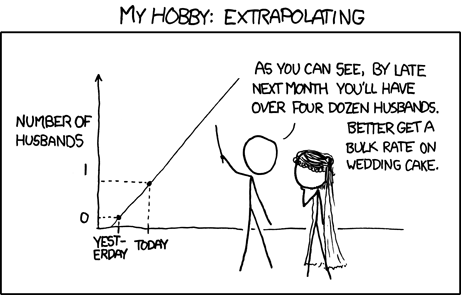
When, when, when will politics get its ugly, opinionated, ignorant backside out of learning? Actually, it often seems that the moment something goes mainstream - a practice that kinda worked in a particular context, extrapolated beyond all reason - dogma and ill-informed dictate overturn good intention. Reminds me of this xkcd cartoon:
What follows is my random musing. Feel free to switch off at this point, or go visit some more of those fab xkcd cartoons if you'd rather! :o)
Anyway, it often seems to me that politicians can't seem to steer away from an inherent belief that education is something which must be done to others. "Sit still!! Stand when an adult enters the room. Wear that tie. STRAIGHTEN THAT TIE!!!!! 6 sixes are 36, 7 sixes are 42..."
Real learning seems incidental or sidelined. Provided that predefined 'learning outcomes' and targets are achieved, who cares what really went on in that learner's head, huh? I'm also bothered by the idea of setting by ability as if ability remained static. As if ability was measured by volume. That somehow you're given a certain amount in this life. We'll teach to that ability, no more and no less. Just doesn't make sense to me that 'ability' is a label which is so happily bandied about. Label this child as 'gifted', that child as 'weak'. No get out of jail. No chance of parole. You are the ability you're allotted.
Education = Extrinsic motivation, carrot and stick, rules and requirements
Learning = Intrinsic motivation, enjoyment, creativity, expansion, curiosity etc...
How much easier to meddle with the former. How much damage to inflict on the potential of the latter? Today's musing is done. More pondering later no doubt!
PS They don't wear uniforms at my kids' school either. Shocker, huh? :o)
Why David Cameron's schools policy is out of date | Politics | The Guardian:
"We can stop worrying about how to improve schools. It's simple, according to David Cameron. It's a good school if it's got a uniform, and children get up when an adult walks into the room, and teachers set and teach by ability. That clear? Good. But try telling Sean O'Regan that all good schools have uniforms. He runs Edith Neville primary school, with one of the most deprived intakes in London. Its results are brilliant, Ofsted calls it an outstanding school, and it has no uniform. 'People think a uniform is a shortcut to raising standards of behaviour,' O'Regan says, 'but it is not.'*shudder*
School uniforms are a British obsession. In most of Europe and America, they don't bother. It always seems to be the apostles of economic liberalism who are keenest to dictate every inch of what our children wear. I'm not saying uniforms are always wrong. I've met heads who make good use of them. It's ignorant to make a simple rule out of it. The same applies to teaching by ability. There's a lot to be said for setting – placing children in ability groups for different subjects – though much less for streaming."
When, when, when will politics get its ugly, opinionated, ignorant backside out of learning? Actually, it often seems that the moment something goes mainstream - a practice that kinda worked in a particular context, extrapolated beyond all reason - dogma and ill-informed dictate overturn good intention. Reminds me of this xkcd cartoon:
What follows is my random musing. Feel free to switch off at this point, or go visit some more of those fab xkcd cartoons if you'd rather! :o)
Anyway, it often seems to me that politicians can't seem to steer away from an inherent belief that education is something which must be done to others. "Sit still!! Stand when an adult enters the room. Wear that tie. STRAIGHTEN THAT TIE!!!!! 6 sixes are 36, 7 sixes are 42..."
Real learning seems incidental or sidelined. Provided that predefined 'learning outcomes' and targets are achieved, who cares what really went on in that learner's head, huh? I'm also bothered by the idea of setting by ability as if ability remained static. As if ability was measured by volume. That somehow you're given a certain amount in this life. We'll teach to that ability, no more and no less. Just doesn't make sense to me that 'ability' is a label which is so happily bandied about. Label this child as 'gifted', that child as 'weak'. No get out of jail. No chance of parole. You are the ability you're allotted.
Education = Extrinsic motivation, carrot and stick, rules and requirements
Learning = Intrinsic motivation, enjoyment, creativity, expansion, curiosity etc...
How much easier to meddle with the former. How much damage to inflict on the potential of the latter? Today's musing is done. More pondering later no doubt!
PS They don't wear uniforms at my kids' school either. Shocker, huh? :o)
Tuesday, February 23, 2010
The ePortfolio myth

So... anyway... my thought. It concerns the oft touted phrase you hear in, oh, probably the second breath after the word ePortfolio and that is 'supporting lifelong learning'. Everyone's at it, from manufacturers of ePortfolios to bodies such as JISC. I wondered to myself what do we really mean by that? Lifelong? Seriously??? ePortfolios have been around for a blink of an eye in educational terms and yet... suddenly... they support or even better, they 'harness' lifelong learning. How can anyone make such grandiose claims?
I'm reminded a little of the BBC Doomsday Project which took place when I was a child in the 80s. There we were, writing about our local areas... storing photographs and other snippets to make our mark in history. It really was touted as a Doomsday Book Mark II from what I remember (I was one of the schoolchildren who participated in what was probably an early instance of wiki-esque generation of content!)... and yet... where is it now? Lost to incompatibility and data preservation issues. Published less than 25 years ago - hardly the average lifespan - and yet, gone. Whizz forward a quarter of a century and here we are again spouting about 'supporting lifelong learning' with a technology which is unproven and lacks the basic interoperability standards to help it move towards any kind of sustainability.
Ladies and gentlemen of the jury. I put it to you that ePortfolio is being over-promoted off the back of an unsupportable claim, that of 'harnessing lifelong learning'. Furthermore, I pronounce it 'guilty' as charged.
PS I really don't care whatever it was I wrote for the Doomsday project back in 1984/85 - so, like old family photos, I'll leave leafing through my ancient bits of childhood work for dewy eyed relatives and continue moving forwards with an underpinning of experience, qualifications and confidence which doesn't need a 'lifelong' record of stuff to support.
PPS You didn't see me say this... right? ;o)
PPPS I have a whole other theory about the currency of learning and the expiry date of 'evidence'. But I'll save that ranty waffle for another day.
Tuesday, February 16, 2010
Prezi for Educators
Now, I haven't quite made up my mind about Prezi. I've seen some really interesting presentations, but I've also seen a lot of seasickness-inducing efforts and since the latter outweighs the former, I've been struggling to get a sense of what I could do with it.
However... if you are interested in having more of a go with Prezi and you're a student or teacher... then have a look at the free Student / Teacher license upgrade option. All the stuff you can do with the free account, but an additional ability to make your Prezis private... remove the Prezi watermark... and get an additional 400MB of storage - all of which would normally cost you $59 / year. Gotta be worth an extra look, for that, I reckon!
Monday, February 8, 2010
Let the bad times roll: Job losses bite into HE
One word for this story...
"Ouch"
Read more below:
Difficult times ahead. Could wax lyrical about this being an opportunity for efficiency savings, OER being mainstreamed into education, working smarter not harder, innovating our way out of a restrictive financial climate, opportunities for change etc. But... doesn't the above just suck? Bankers and governments get us into a financial nightmare... and Higher Education gets to pay a significant price as a result.
Ouch.
"Ouch"
Read more below:
Thousands to lose jobs as universities prepare to cope with cuts | Education | The Guardian: "Universities across the country are preparing to axe thousands of teaching jobs, close campuses and ditch courses to cope with government funding cuts, the Guardian has learned.
Other plans include using post-graduates rather than professors for teaching and the delay of major building projects. The proposals have already provoked ballots for industrial action at a number of universities in the past week raising fears of strike action which could severely disrupt lectures and examinations.
The Guardian spoke to vice-chancellors and other senior staff at 25 universities, some of whom condemned the funding squeeze as 'painful' and 'insidious'. They warned that UK universities were being pushed towards becoming US-style, quasi-privatised institutions.
The cuts are being put in place to cope with the announcement last week by the Higher Education Funding Council for England (Hefce) that £449m – equivalent to more than a 5% reduction nationally – would be stripped out of university budgets.
The University and College Union (UCU) believes that more than 15,000 posts – the majority academic – could disappear in the next few years. Precise funding figures for each university will be released on 18 March."
Difficult times ahead. Could wax lyrical about this being an opportunity for efficiency savings, OER being mainstreamed into education, working smarter not harder, innovating our way out of a restrictive financial climate, opportunities for change etc. But... doesn't the above just suck? Bankers and governments get us into a financial nightmare... and Higher Education gets to pay a significant price as a result.
Ouch.
Wednesday, January 20, 2010
eLearning Pedagogy Speak Generator
For those moments when you need to find that latest bit of eLearning pedagogical terminology in an important meeting for high-level funding, I thought you might like my eLearning Pedagogy generator.
Feel free to use at will. :o)
Friday, January 15, 2010
Google docs and sharing stored files

Just noticed a nice new little feature in Google Docs - the ability to upload any type of file without having it converted to a Google Docs. Now, I know this seems like a pretty minor feature but it's actually going to be a useful little bunny to know about if you don't want Google stripping out the formatting for a document you just want to store and share with others. Okay, so there are better services for file sharing which allow you more than the 1GB / 25oMB per file limit imposed by Google (the superb Dropbox is one which immediately pops into my head), but you have to love the convenience... again... of Google allowing you to just get stuff done via a simple tweak to a service.
Stuff which Google has tweaked in Docs lately which has made a difference:
1. File storage without converting your file
2. Sharable folders
3. Bulk uploads
4. Translation of words, phrases or entire pages into any of 40+ languages.
What's not to like?
Sarah 'I sold my soul to Google but I liked what I got in return' Horrigan :o)
Subscribe to:
Posts (Atom)
